

The world's greatest investor: Warren Buffett
has built up a huge fortune with his astute investing, Stockopedia
analyses his style and lets investors see what shares he would buy
The search for the secret of investing success has delivered more than its fair share of fascinating, complicated and sometimes bizarre ideas.
But if there is one thing that shines through that murky soup, it is that having a plan is a good idea.
Working
out some rules and sticking to them is the common factor that joins the
dots between the famous investing names, from Warren Buffett to Ben Graham, Jim Slater and Neil Woodford.
The
problem for the modern-day personal investor though is that it’s one
thing to say you plan on investing like Warren Buffett, but it’s another
thing altogether to have the time to sit down, pick your shares
accordingly and then continue to manage that portfolio.
Interestingly,
for those who prefer to pick their own shares rather than trust their
hard-earned cash to a fund manager and his fees, an investing guru
tracking website Stockopedia aims to solve that exact conundrum.
It takes the idea of share screening and adds in a cunning twist.
Not
only can you drill down into individual stocks, but you can also check
what shares would fit into the strategies of a whole host of famous and
successful investors and build your own portfolio based on this.
That
means that if you do fancy investing like Warren Buffett, you can take a
look the portfolio of UK shares that match his investing criteria,
check their performance and then drill down to take a better look at
those companies.
The
Buffettology sustainable growth portfolio on the site is up 11.75 per
cent since inception in mid-December, beating the FTSE 100’s 4.6 per
cent gain and has an annualised projected return of 21 per cent. Stocks
that fit include property listings firm RightMove, Domino’s Pizza and
drugs giant AstraZeneca, among others.
If
you don’t fancy Buffett you could try shares that match famed UK
stock-picker Jim Slater’s Zulu Principle, a portfolio that matches value
investing godfather Ben Graham’s ideas, or even baskets that adopt
academic research, such as Josef Piotroski’s F-score.
Each
portfolio includes the list of UK shares that match its criteria and
investors can click through to investigate the fundamentals of
individual shares in more detail. Stockopedia comes with a £14.99 a month or £149.99 a year subscription charge.
Read More...
- INVESTING TIPS: Top fund and trust ideas for incom...
- INVESTING TIPS: Top fund and investment trust idea...
- INVESTING IDEAS: How to invest like Warren Buffett...
Why follow a strategy?
Ed
Page-Croft, the mastermind behind Stockopedia, explains that the
investing guru portfolio idea is not aimed at delivering individual
share picks, but instead a basket of shares that all-important
strategy.
Delving deeper into shares
Follow the investing guru
portfolios through to the individual company pages of Stockopedia and
there is a wealth of share information derived from Thomson Reuters
data.
Here investors will find charts, a balance sheet running back five years and a host of investor ratios highlighted, from the commonly used such as the price to earnings (P/E) and Earnings Per Share ratios, to more complicated measures such as EV to EBITDA (Enterprise Value to Earnings before Interest, Taxes, Depreciation and Amortisation).
Financial strength measures and share dangers signs are also featured, such as the Piotroski F-Score, along with broker forecasts.
Fortunately, for anyone slightly baffled by that rather jargon-heavy summary of what’s on offer, not only does Stockopedia highlight these things but it also explains in simple terms what they are, why they are important and how they are used.
Here investors will find charts, a balance sheet running back five years and a host of investor ratios highlighted, from the commonly used such as the price to earnings (P/E) and Earnings Per Share ratios, to more complicated measures such as EV to EBITDA (Enterprise Value to Earnings before Interest, Taxes, Depreciation and Amortisation).
Financial strength measures and share dangers signs are also featured, such as the Piotroski F-Score, along with broker forecasts.
Fortunately, for anyone slightly baffled by that rather jargon-heavy summary of what’s on offer, not only does Stockopedia highlight these things but it also explains in simple terms what they are, why they are important and how they are used.
A former Goldman Sachs broker and a technology buff, Ed is also a private investor and keen student of investing philosophy.
He
says that one of the biggest mistakes individual share pickers make is
that their holdings are far too tightly focused, with on average many
investors only owning a handful of different stocks and ploughing into
hit or miss companies, encouraged by whatever the hot topic of the
moment is.
This is
hardly surprising when investors are bombarded with more information and
opportunities to trade than ever before, yet among all those tips and
get rich schemes there is a rich seam of solid investing wisdom that is
rarely mined.
These are
the books and academic papers that go into great detail on the famous
investors and their methods. Astonishingly, in the great investing rush a
lot of this potential gold dust gets overlooked, despite decades of
evidence to show that many of these strategies work and the fact that
some have made the gurus behind them very rich.
It
is this wealth of information that Stockopedia has drawn on to build
screens that enable investors to find the shares that for a portfolio
following that strategy.
Ed
believes it is essential investors to use the information is as a
portfolio builder rather than cherry-picking from them. He says:
‘Everyone is often looking for a hot tip but our job is building these
lists to let people make their own decisions. I would want to buy the
lists as a whole, so you are picking up the characteristics of those
shares rather than individual companies.'
‘We have about 65 portfolios and the last time I looked about 75 per cent were beating the market this year.’
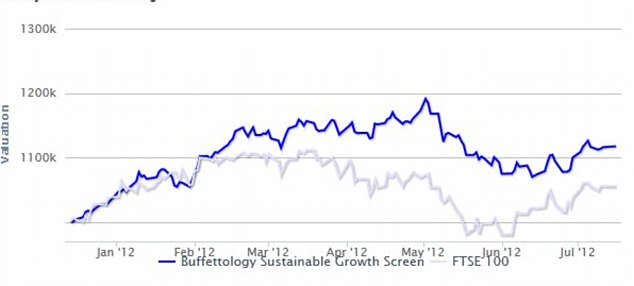
Market-beating: The Buffettology portfolio is up
11.75 per cent on its mid-December inception, compared to the FTSE 100
index's 5.5 per cent return.
Pick the winners you don’t know about and avoid the traps
One
of the advantages of using a share screening service like Stockopedia
is that it helps throw up companies that you would otherwise not find
out about.
It also helps investors avoid getting caught in the traps that even the biggest household name dividend shares can lay.
Smaller companies
One
of investing’s truisms is that the big company shares that attract the
most broker recommendations, analyst research and column inches are
rarely the ones that will deliver the bumper returns investors dream of
bagging.
Midas Extra: Sign up for exclusive share tips
Midas Extra is the weekly newsletter that includes exclusive ideas from Financial Mail on Sunday's share tipster.
It highlights stocks that you may not hear about but could deliver solid returns.
A Midas Extra Update recently highlighted one such share camera specialist Vitec, up 36 per cent on the tip 18 months.
Find out more about how you could sign up for Midas Extra here
It highlights stocks that you may not hear about but could deliver solid returns.
A Midas Extra Update recently highlighted one such share camera specialist Vitec, up 36 per cent on the tip 18 months.
Find out more about how you could sign up for Midas Extra here
Smaller companies and mid-sized firms
on the other hand have great potential for growth but lie at the
riskier end of the investing spectrum, as it takes much less to blow
them off course than it does a FTSE 100 blue-chip giant.
Jim
Slater, the share picker who came to fame through his share column in
the Sunday Telegraph, outlined this in his investing bible The Zulu
Principle. He picked that name for the book to highlight how it is
easier to become an expert in less well-researched areas of life - not many people know much about the Zulus, so learn a little about them and you are soon better versed than most.
Slater
wrote: 'Most leading brokers cannot spare the time and money to
research smaller stocks. You are therefore more likely to find a bargain
in this relatively under-exploited area of the stock market.'
The
problem is that finding those smaller gems that combine good growth
prospects with a solid backing can be tough, but set a screen to work
and you can check for red flags that highlight any dangers from factors
such as too much debt.
The income shares dividend trap
On
the other side of the coin to those hunting smaller growth companies or
undervalued shares, many investors like to look to higher-yielding
dividend shares, yet even these come with pitfalls.
The
classic dividend trap share is a big name currently offering high
income that investors are lured into believing is hugely undervalued, in
fact, often it is actually a warning sign of bad things to come, as in
the case of HMV’s bumper 10 per cent yield a few years ago.
Just
as running a screen can help you pick out smaller unknown gems it can
also sort the wheat from the blue-chip dividend chaff.
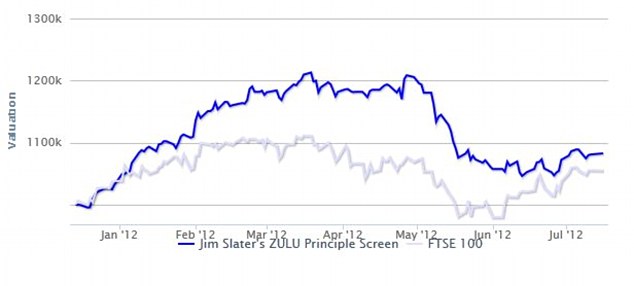
Hunting out hidden gems: Jim Slater's Zulu
Principle portfolio is short on big names but has a forecast annualised
return of 14.5 per cent on current performance
So do investing guru portfolios make you money?
The portfolios on Stockopedia are
tracked daily on their performance and adjusted every three months, with
shares that no longer meet criteria booted out.
The
site explains it thus: ‘Risk and returns are tracked each day. The
charts and tables…give an immediate overview of how a strategy has
performed over time. We build a portfolio of equal weighted positions
across the top 25 candidate stocks for each stock screen and rebalance
the portfolio quarterly.’
Scanning
through those portfolios is an interesting exercise. Most seem to have
beaten the market, but the performance is only tracked through to their
inception – typically the start of the year – so it is hard to get a
fully tested long-term view.
The
portfolios do come with annualised performance figures though (laying
out what they would expect to achieve annually), some of which are very
impressive. The Dividend Achievers screen has a 16.9 per cent annual return, the Buffettology Sustainable Growth screen records 21 per cent, while the Naked Trader screen delivers a bumper 32 per cent.
What’s the catch to investing like this?
Firstly,
as Stockopedia is extremely keen to stress, these are just ideas and
investors should not simply blindly follow any of these screens, however
rich the big name they are based on.
If
you are going to be an individual share-picking investor then you need
to be willing to put in the time and commitment to delve properly into
company figures with some solid personal research, albeit this is
something that Stockopedia’s useful and easy to navigate data can help
with.
So this isn’t a
get rich quick shortcut that means you can just pick a portfolio because
you like the look of its performance figures, then just buy all the
shares, sit back, relax and put the Porsche on order.
How to invest in funds and trim your costs
The sheer amount of work involved in
individual share picking, combined with the tendency for investors to
either stop at too few stocks or end up buying too many similar
companies, means that many are better off leaving professional managers
to do the job for them in funds or investment trusts.
The other option is to use low-cost passive tracker funds or exchange traded funds to simply track an index – these will never beat the market, but then neither do many actively-managed funds year-in, year-out.
The other option is to use low-cost passive tracker funds or exchange traded funds to simply track an index – these will never beat the market, but then neither do many actively-managed funds year-in, year-out.
The other problem is that deciding to
be your own fund manager is expensive, compared to the low dealing
charges incurred investing in a similar sized basket of shares through
an individual fund or investment trust.
Building
a portfolio of 20 shares can prove an expensive endeavour thanks to
dealing costs. Even an investor using a relatively low-cost online share
dealing account is likely to end up paying £10 per purchase dealing
costs, amounting to £200 on a 20-share portfolio.
On
a £5,000 portfolio that is the equivalent of a 4 per cent charge,
whereas on a £10,000 portfolio it is 2 per cent. Investors also need to
pay stamp duty of 0.5 per cent on share purchases.
Ideally,
such a portfolio should not involve too much trading and dipping in and
out of stocks, so further dealing fees will be kept to a minimum –
although some screens are likely to find shares falling out more often
than others.
Investors
also need to consider the cost of adding to their investments and how
this will involve extra dealing costs. One of the best ways to build
your funds over time is regular monthly saving, however, even the
cheaper platforms for monthly share purchases tend to charge about £1.50
per month per line of shares.
That
makes investing monthly over 20 shares very expensive, with a £30
charge eating 6 per cent of even a substantial £500 per month savings
plan. One way round this would be
to rotate investments, into perhaps five shares per month, taking
charges down to £7.50 – this is a 1.5 per cent of a £500 monthly
investment.
Of course,
those charges will seem like small fry if deciding to invest like a guru
helps you strike it rich and you do manage the bumper 20 per cent a
year returns that a portfolio like the Buffettology screen highlights.
Remember
though, even when dealing with methods that have made some very famous
investors very rich indeed, past performance is no guarantee of future
gains!
Read more:
Growing clamour for Diamond to go: Barclays chief could go in days after Cameron joins the attack
A new nightmare on Wall Street? U.S. banks face criminal probe into global interest rate-fixing scheme as Barclays blows the whistle on America's financial giants
How many other banks will be drawn into the market-rigging scandal? Barclays is just the tip of the iceberg, say U.S. investigators
Sack them! Hang them! MPs deliver their collective verdict on bankers

Thank you for sharing such valuable information and knowledge. It is very useful and informative. It would be great to see more updates from you soon.
BalasHapusShares to Buy